
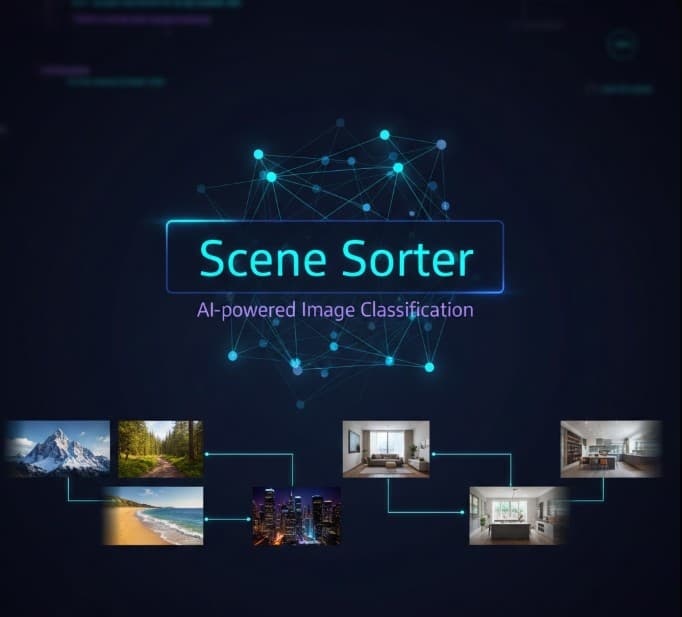
Scene Sorter — From Curiosity to a Real-World AI System
Scene Sorter is not just a computer vision project for me — it represents a phase in my journey where I consciously moved from learning concepts to building systems that solve real problems.
Like many people entering AI and ML, my journey started with curiosity. I was fascinated by how machines could “see” images, recognize patterns, and make decisions that felt almost human. At first, this curiosity stayed at the theory level — reading about convolutional neural networks, watching tutorials, and experimenting with small examples.
But over time, I realized something important:
Understanding concepts is valuable, but real learning happens when those concepts are applied to real problems.
That realization is what led to the idea behind Scene Sorter.
The Problem I Wanted to Solve
In the real world, people deal with large collections of images all the time — personal photo libraries, datasets for ML training, media repositories, and more. Manually organizing these images into folders based on scene or environment is:
- Time-consuming
- Error-prone
- Not scalable
This is a perfect example of a task that humans can do, but should not have to do manually when intelligent systems can automate it.
The problem became clear to me:
Can a deep learning system automatically understand the scene in an image and sort it accordingly?
This simple question became the foundation of Scene Sorter.
Moving From Idea to System
Instead of treating this as just another model-training exercise, I approached Scene Sorter as a system-building project.
My goal was not only to train a model, but to design an end-to-end pipeline that resembles how real AI solutions are built and used.
This meant thinking about:
- Data preparation
- Model selection
- Preprocessing pipelines
- Inference logic
- Extendability for future improvements
Technical Approach
At the core of Scene Sorter is a convolutional neural network (CNN) trained to classify images based on their scene type.
Key components of the system include:
-
Image preprocessing
Images are resized, normalized, and prepared in a consistent format before being passed to the model. This step turned out to be critical for stable performance. -
Deep learning model
A CNN-based architecture is used to extract visual features that differentiate scenes such as indoor, outdoor, natural environments, or urban settings. -
Inference pipeline
Once trained, the model can take unseen images and predict their scene category, enabling automatic sorting and organization.
Rather than focusing solely on achieving the highest possible accuracy, I focused on building a clean, understandable, and extensible system — something that could realistically be improved and scaled.
Challenges Faced
Like any real-world AI project, Scene Sorter came with challenges:
-
Dataset quality matters more than expected
Inconsistent labels and poor-quality images can drastically affect model performance. -
Preprocessing is not optional
Small changes in preprocessing had noticeable effects on results. -
Model performance vs. complexity trade-offs
A more complex model is not always the better solution.
These challenges reinforced an important lesson for me:
AI is as much about engineering decisions as it is about algorithms.
What I Learned From This Project
Scene Sorter helped me develop skills that go beyond training a model:
- Translating a vague idea into a clear problem statement
- Designing an end-to-end ML pipeline
- Understanding practical limitations of computer vision systems
- Thinking about AI projects from a product and system perspective, not just experimentation
This project also strengthened my belief that real-world problem solving requires implementation, iteration, and patience.
Why Scene Sorter Matters to Me
Scene Sorter represents a shift in my mindset:
From:
- Learning AI concepts in isolation
To:
- Applying AI to solve meaningful, real-world problems
It reflects how I approach projects today — start with a problem, design a system around it, and build with scalability and clarity in mind.
Looking Ahead
Scene Sorter is intentionally designed to be extendable. With more data, improved architectures, or integration into larger systems, it can evolve further.
More importantly, the lessons learned from this project continue to influence how I approach new challenges in AI, ML, and system design.
Final Thoughts
Scene Sorter is not about showing off a model.
It’s about demonstrating a way of thinking — problem-first, system-driven, and implementation-focused.
This project is one step in a much longer journey, but it’s an important one.